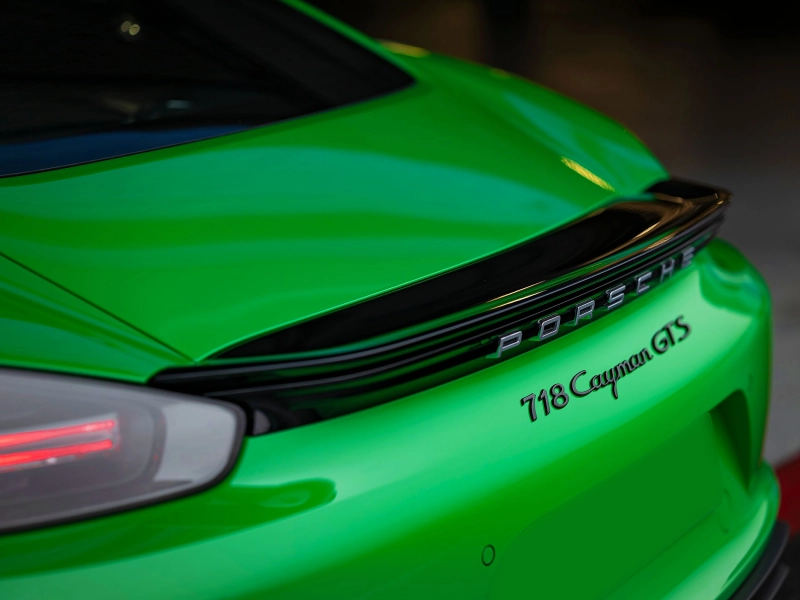
Porsche in a stalemate: Electric future of Boxster and Cayman uncertain
The auto industry is going through a period of brutal recalibration, and Porsche, one of the pioneers of luxury electrification, is not immune to these paradigm shifts. According to recent information appearing in the international press and confirmed by Bloomberg analyses, the Zuffenhausen-based manufacturer is considering a radical decision: suspending or even abandoning certain electric performance projects, including the long-awaited successors to the 718 range.
A change of strategy forced by reality
Although Porsche previously aimed for 80% of its sales to be electric vehicles (BEVs) by 2030, the initial enthusiasm seems to have hit a wall of development costs and supply issues.
The electric 718 Boxster and Cayman, which were supposed to define the new era of zero-emission sports cars, are now at the center of intense internal debate. Sources close to the company suggest that the brand's officials, under the leadership of CEO Oliver Blume, are analyzing the economic viability of these projects, in the context of:
- Production costs exceeded initial estimates.
- Global demand for premium electric cars saw an unexpected slowdown in 2025.
- The battery infrastructure has suffered a major blow with the financial instability of strategic partner Northvolt.
The Domino Effect: From Batteries to Heat Engines
Problems began to surface as early as December 2024, but the critical point was reached in May 2025. The bankruptcy (or reorganization under protection) of Swedish battery manufacturer Northvolt left Porsche without the main source of high-performance cells needed to maintain the low weight of the 718 models.
Faced with this blockage, Porsche has already started "Plan B":
- Platform re-engineering: In September 2025, the brand confirmed that the platform originally conceived as exclusively electric is now being modified to also accommodate internal combustion engines (ICE).
- Dynamic parity: Engineers are working against the clock to ensure that the petrol versions are not just "alternatives" but are at the top of the range in terms of performance, satisfying purists who are not yet ready for the quietness of the electric motor.
What's next for Porsche fans?
Although the launch of the electric 718 models was scheduled for late 2025 or early 2026, the postponement now seems certain. Moreover, there is a risk that these models will only be launched in select markets, while the rest of the world will receive hybrid or purely thermal versions.
"We want to respond to new market realities and the demands of our customers," said Oliver Blume, suggesting that Porsche would rather delay technological progress than sacrifice profitability or brand identity.
This "handbrake" pulled in the midst of the electrification process shows that, in 2026, the road to the green future is much more difficult and expensive than the major builders anticipated.
Electric Evolution: Zero-emission Porsche Models in Romania (2026)
Despite the uncertainty surrounding the future of the 718 sports car, Porsche has stepped on the accelerator in the electric SUV and luxury sedan segment. In February 2026, the electric range is stronger and more diverse than ever, offering 800V charging technologies and physics-defying performance.
The New Porsche Cayenne Electric (Launch of the Year)
The brand's most popular model has officially switched to electric propulsion, becoming the most powerful series-production Porsche in history. Built on the PPE (Premium Platform Electric), it offers an increased wheelbase and a revolutionary digital interior with screens that stretch across the entire width of the dashboard.
- Autonomy: Up to 642 km (WLTP).
- Technology: Record charging at 400 kW (10-80% in under 16 minutes) and, for the first time, inductive wireless charging (11 kW).
- Performance (Turbo): 1,156 HP and acceleration 0-100 km/h in 2.5 seconds.
Porsche Macan Electric
Quickly becoming a favorite in Bucharest and Cluj, the Macan Electric is now the only version of the compact SUV available for new order. It is appreciated for its urban agility and surprising energy efficiency.
- Range: Up to 641 km (Macan version with rear-wheel drive).
- Battery capacity: 100 kWh (net 95 kWh).
Porsche Taycan (Facelift)
The brand's electric pioneer remains the benchmark for driving dynamics. The updated version (Gen 2) has addressed key customer complaints, offering significantly greater real-world range and improved charging speed.
Porsche Electric Price List (Romania, February 2026)
The prices below include VAT and standard equipment specific to the Romanian market.
| Model | Version | Starting Price (incl. VAT) | Power (with Launch Control) |
| Macan Electric | Macan (RWD) | €86,661 | 360 PS |
| Macan 4 | €90,220 | 408 PS | |
| Macan Turbo | €122,130 | 639 PS | |
| Cayenne Electric | Cayenne Electric | €108,040 | 442 PS |
| Cayenne Turbo Electric | €168,525 | 1,156 PS | |
| Taycan | Taycan (Sedan) | €109,590 | 408 PS |
| Taycan Turbo S | €224,106 | 952 PS | |
| Taycan Turbo GT | €255,234 | 1,108 PS |
Top 3 Reasons Why Romanians Choose Porsche Electric in 2026
- Porsche Destination Charging network: Customers in Romania benefit from dedicated ultra-fast charging stations at dealers in Bucharest and Timisoara, plus premium locations (hotels, restaurants) on routes to the mountains or the sea.
- Taxes and Amenities: Even in 2026, the annual tax remains symbolic (approx. 40 lei), and free parking in big cities and access to bus lanes (under certain conditions) attract business clients.
- Turbo Electric Performance: In Romania, the Turbo Electric variant of the Cayenne model has generated massive interest, being considered the spiritual replacement for the old V8 models, offering an instant torque of 1,500 Nm, ideal for safe overtaking on national roads.
A fragile balance between tradition and volts
The year 2026 finds Porsche in a moment of unprecedented strategic introspection. If a few years ago the path to full electrification seemed a straight line, the reality of the global market and the supply chain crisis – culminating in the problems of partner Northvolt – have forced the Stuttgart brand to demonstrate unexpected flexibility.
The uncertainty surrounding the electric 718 Boxster and Cayman isn't just an engineering problem, but a symptom of a market that's not yet ready to completely give up the thrill of the combustion engine. The decision to adapt the platforms for mixed propulsion is a sign of pragmatism: Porsche has understood that in order to finance the electric future, it must continue to sell the present that fans love.
Future prospects:
- For purists: The return of combustion engines under discussion for the 718 range represents an unexpected victory and an extension of the "analog" era.
- For technology customers: Models like the Cayenne Electric and Macan Electric remain pillars of stability, offering performance figures that surpass any gasoline-powered predecessor.
- For the Romanian market: Interest remains high, but local customers are becoming more selective, carefully analyzing the relationship between charging infrastructure and real autonomy.
Ultimately, Porsche isn't giving up on innovation, but instead opting to implement it with an activated "safety brake." Whether your future sports car will emit a boxer engine sound or a high-frequency electric hum, one thing is certain: Porsche will prioritize the driving experience over industrial ideology. It remains to be seen whether this recalibration will keep the brand at the top of the automotive pyramid or whether it will irreparably slow down the transition to a zero-emission future.