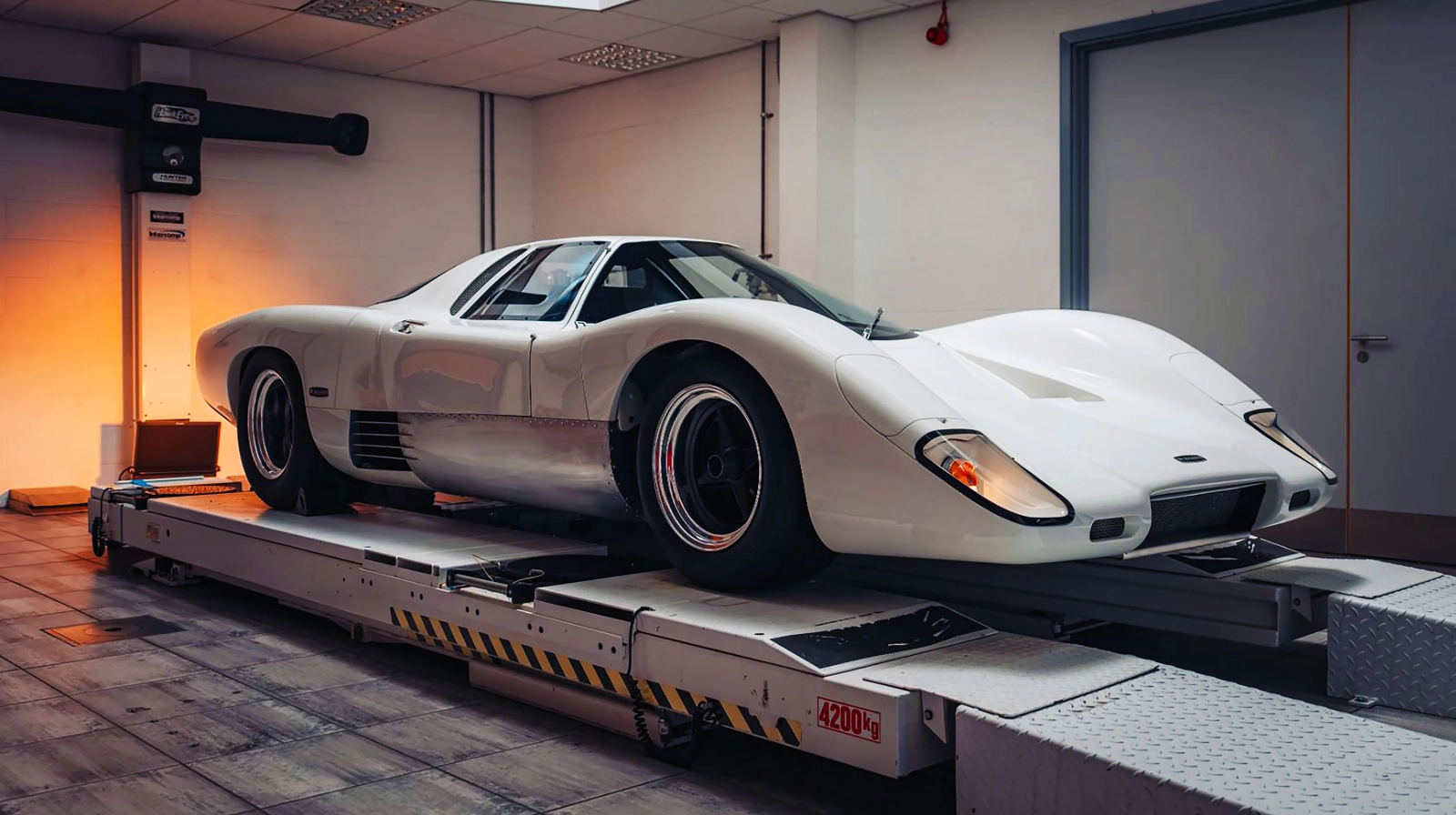
McLaren has remade history - The brand's first road-going supercar, the legendary M6GT, has been rebuilt from scratch
A common misconception among car enthusiasts is that the famous 1993 McLaren F1 was the British manufacturer's first foray into the world of production cars. In reality, the origins of the road-going division go much further back in time. McLaren Special Operations (MSO) has recently brought the brand's true pioneer back to life: the M6GT, a 1969 model rebuilt almost entirely to its original specifications and materials.
Born from the genius of founder Bruce McLaren, the M6GT project was conceived as a street version of the M6A racing model, a top-of-the-line car that had definitively dominated the North American Can-Am championship in the late 1960s. The New Zealander's initial plan was ambitious and called for the assembly of 50 road-legal examples. Unfortunately, the tragic accident in 1970 in which Bruce McLaren lost his life put an early end to this dream, with only two units being produced, one of which served as the founder's personal car.
To revive this rare piece of automotive history, MSO embarked on a painstaking restoration process. Engineers reconstructed the vehicle using vintage sketches, photographs taken more than 55 years ago, and factory-identical materials. A particular challenge was deciphering the component mounting points, which were originally calculated in imperial units of measurement — a system that Britain abandoned in the 1960s in favor of the metric system.
Under the aerodynamic hood is a pure mechanical heart, typical of the golden age of motorsport: a 5.7-liter Chevrolet V8 engine, capable of developing approximately 370 horsepower. The resources are managed through a 5-speed manual transmission, the assembly propelling the car to an estimated top speed of 265 km/h, a remarkable performance for those times.
Aesthetically, the M6GT impresses with details loaded with historical significance. The bodywork is finished in White Colnbrook, a name that pays homage to the location where Bruce McLaren laid the foundations of this first street project. Inside, the cabin stands out for its functional minimalism: the seats are upholstered in green, a direct reference to the M2B model, the first Formula 1 single-seater in the team's history. The dashboard is completely analog, and the centerpiece of the transmission is a gear lever carved from walnut.
Through this radical reconstruction, McLaren not only honors its past, but also restores the exact chronology of its evolution: the legendary F1 was not the beginning, but the spectacular continuation of a vision that came to life in 1969, with the M6GT.