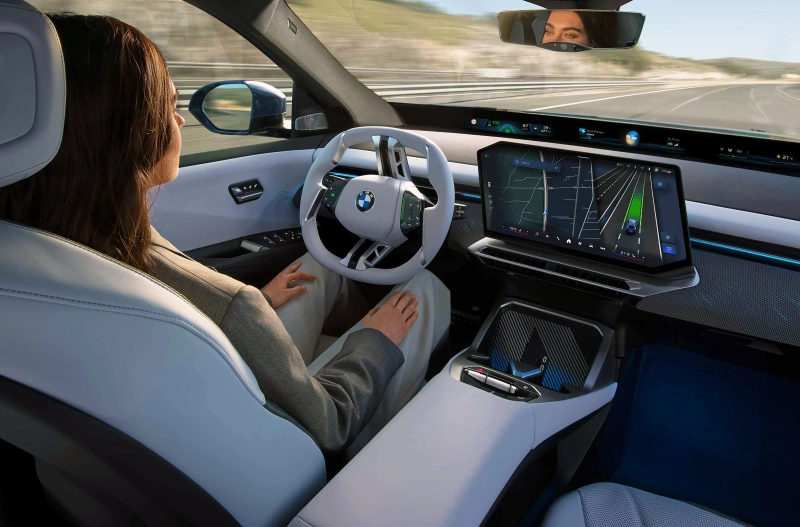
200 million kilometers without hands on the wheel: BMW Highway Assistant technology conquers Europe. When will it arrive on Romanian highways?
The BMW Highway Assistant autonomous driving system has long since ceased to be just a promise in research laboratories and has become an everyday reality for hundreds of thousands of drivers. The latest figures published by the Bavarian manufacturer confirm a historic milestone: customers of the German brand have already covered a total of more than 200 million kilometers without touching the steering wheel, a distance equivalent to more than 5,000 times around the Earth.
While markets in North America and Western Europe massively adopt this extended Level 2 technology (SAE Level 2+), a natural question arises: how much do Romanians use this system and when will we be able to take our hands off the wheel on our highways?
What does BMW Highway Assistant offer?
The technology is integrated into the manufacturer's current luxury range, being available on models such as the BMW iX3 (new generation), 5 Series, 7 Series, iX, X5, X6, X7 and XM. The system allows drivers to drive completely "hands-free" on pre-approved motorway sections, up to a maximum speed of 130 km/h.
Unlike classic assistance systems, the new Highway Assistant offers a fluid and predictive experience:
- Full Entry-to-Exit support: While navigation via BMW Maps is active, the car manages the trajectory, distance and speed from the motorway entrance to the exit.
- Lane change by looking: When the system suggests overtaking a slower vehicle, the driver only needs to look in the corresponding side mirror to confirm the maneuver and the car will change lanes completely automatically.
- BMW Symbiotic Drive: A major development introduced on the new generation of models, which allows the driver to finely intervene on the steering wheel or pedals without completely deactivating the lateral and longitudinal guidance, providing a natural transition between man and technology.
Safety first: The system is based on a redundant architecture based on video cameras, high-resolution maps and a dedicated safety chip on the ADAS computer. At the same time, an interior video camera constantly monitors the driver's attention (gaze direction and eye condition), reminding them that they remain directly responsible for driving and prompting them to take over the wheel in complex areas or when approaching an exit.
Expansion in Europe: Where is Romania?
Until recently, the use of the system was strictly limited to Germany, the USA and Canada. With the European approvals of DCAS (Driver Control Assistance Systems), BMW has started a massive expansion in over 20 countries on the Old Continent. However, the geographical implementation is being done in progressive waves:
| Rollout Stage | Countries Included | Status |
| Wave 1 (Launch) | Germany, Austria, Switzerland, Italy, France, and the Benelux countries | Available now |
| Wave 2 | United Kingdom, Ireland, Spain, and Portugal | Currently being activated |
| Wave 3 | Northern Europe, Eastern and Southeastern Europe (including Romania) | Future release |
How much do Romanians use it today?
The direct answer is: on the territory of Romania, the hands-free function cannot yet be used natively. According to the official calendar of the German group, the activation of the system for Eastern Europe will be done at a later date. This is dictated both by the need for high-resolution digital mapping of our highways, and by the adaptation of local road legislation to the new European standards of driver assistance.
However, the BMW customer community in Romania already interacts with this technology in two ways:
- International travel: Romanian owners of compatible models (who purchased the cars with the top assistance packages) can activate and use Highway Assistant as soon as they cross the border into the highway network of Hungary, Austria or Germany. For those who travel frequently to Western Europe for business or vacation, the system has already become an essential tool for reducing fatigue on long journeys.
- Existing hardware "on the carrier": Even if our roads still suffer from perfect markings or face unpredictable obstacles, cars delivered to showrooms in Romania come ready-equipped with sensors, attention monitoring cameras and basic software, just waiting for regional over-the-air unlocking.
Conclusion
The 200 million kilometers driven without hands on the wheel globally demonstrate that the future of autonomous driving is no longer science fiction, but an extremely certain statistical reality. For customers in Romania, the BMW Highway Assistant technology represents an extremely close horizon. Until the local digital infrastructure is fully mapped and approved, Romanian drivers remain with their hands on the wheel at home, but are ready to experience complete freedom as soon as they cross the borders to the west.