Ford and Renault Ally Against the Chinese Threat: Europe's Electric Future and the Implications for Romania
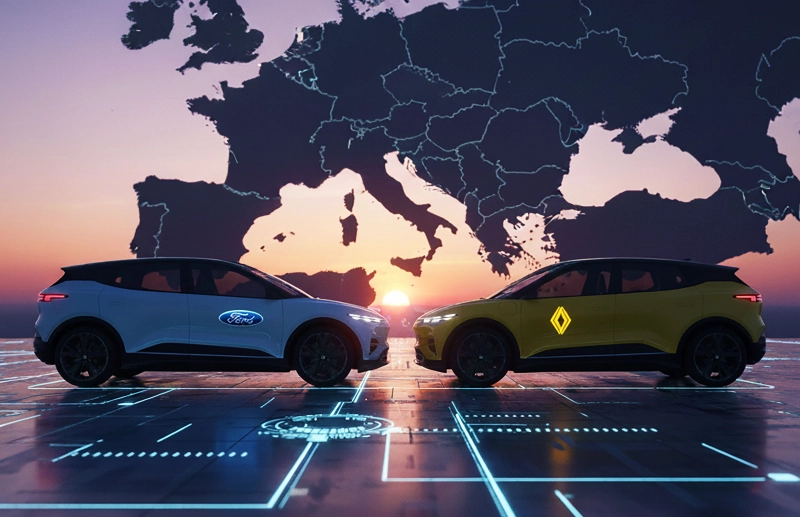
The European auto industry is at a crossroads, and the answer comes in the form of a surprising strategic alliance. Ford and Renault Group have announced a historic partnership to jointly develop and produce future electric models for the European market, as well as explore cooperation in the light commercial vehicle (LCV) segment.
This move is not just a simple collaboration; it is a clear signal that Europe's traditional auto giants are joining forces to face a common and increasingly powerful adversary: Chinese manufacturers of affordable electric vehicles (EVs), which are putting enormous pressure on Europeans' profit margins and market share.
Partnership Details: Electric and Accessible
The central element of the agreement, signed on December 9, 2025, targets the electric car segment:
- Common Platform: Ford will launch two new electric models, designed by its design team, but using Renault Group’s Ampere Small (AmpR Small) electric platform. This architecture underpins Renault’s upcoming small and affordable models, including the new Renault 5 and the upcoming Twingo electric.
- The goal: The main goal is to reduce costs and development time to offer small, affordable EVs, a vital segment currently dominated by offerings from Asia. The executives of the two manufacturers stressed that it is a fight "for the survival of our industry."
- Production: The two Ford models, expected on the market from 2028, will be manufactured at the Renault ElectriCity hub in northern France.
- Light Commercial Vehicles (LCVs): The companies also signed a letter of intent to explore the joint development and production of certain LCV models under both brands, a segment in which both manufacturers have a strong presence.
The agreement allows Ford to benefit from Renault/Ampere's efficiency and speed in developing low-cost EVs, while Renault expands its platform usage and production scale, strengthening its position in the European market.
What Does This Alliance Mean for Romania?
The impact of this collaboration on Romania, where Renault (through Dacia) and Ford are key economic players and the largest exporters, is nuanced, with potential advantages and risks.
Potential Positive Implications
- Strengthening Renault/Dacia Competencies: The partnership underlines the competitiveness of Renault’s electric platform (Ampere), which also includes future Dacia models. If the platform proves to be a success in terms of costs and efficiency, this could strengthen Dacia/Mioveni’s strategic position within the Renault Group. Future investments could continue to focus on the efficiency of the Ampere platform, also indirectly benefiting from the know-how gained from the collaboration with Ford.
- Cooperation on the LCV Segment (Ford Otosan Craiova): Ford already produces light commercial vehicles at the Craiova plant (Ford Otosan Romania). The letter of intent on cooperation on the LCV segment could theoretically open the door to synergies and even joint production programs at Craiova or at its partners in Turkey. An increase in efficiency and volume in this segment would be beneficial for maintaining jobs and investments in Craiova.
Risks and Uncertainties
- EV Production Exclusively in France: The decision to produce the two Ford models on the Renault platform exclusively in France, at the ElectriCity hub, directly eliminates Craiova from the equation of production of these new electric cars. Although Ford Craiova currently produces the Puma electric SUV, the new partnership does not bring additional volumes of EV cars to Romania.
- Cost Pressure: The desire to produce cheaper EVs to compete with China is putting huge pressure on costs. If this pressure translates into the need to relocate production or drastically streamline supply chains, factories with higher operating costs (such as those in Romania, where energy and labor costs have been sensitive points) could be subject to constant evaluations.
- Long-Term Future of Platforms: In the long term, the success of this alliance depends on the ability to innovate quickly and keep costs low. If Dacia and Ford manage to establish themselves in the affordable EV segment, the Romanian auto market – both through production and through the supplier network – will benefit from the stability of the two major employers.
Conclusion
The Ford-Renault partnership is a sign of the times in the European auto industry: the need to collaborate to face global competition and the costly transition to electric mobility.
For Romania, the agreement has a mixed impact. On the one hand, it shows a change in Ford's priorities in Europe, with the risk that the development of new cars will be concentrated in France. On the other hand, it could strengthen Dacia/Renault's position and create new opportunities in the LCV segment in Craiova. The survival and success of the two giants on the European market is, in essence, good news for the Romanian economy, which depends heavily on the automotive industry.