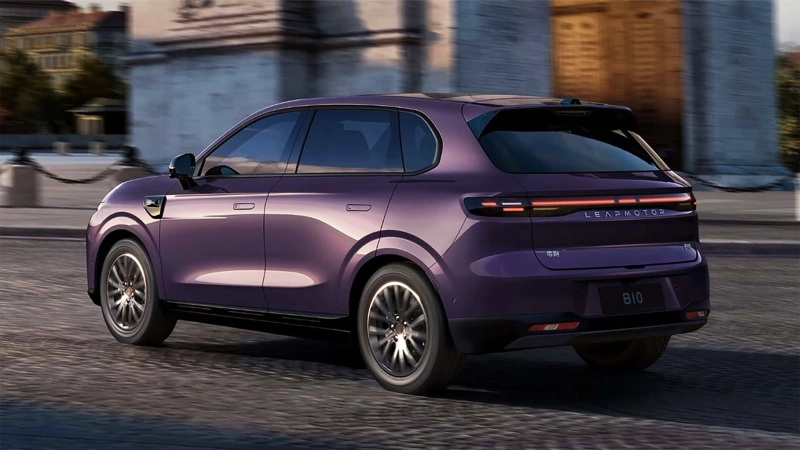
From the Great Wall to Zaragoza: Leapmotor chooses Spain, while Romania remains "in the parking lot"
While the European auto industry is at the crossroads between electrification and protectionism, the Chinese manufacturer Leapmotor has just signaled the direction of travel: west. Far west. The strategic partnership with the giant Stellantis has begun to bear the most tangible fruits, transforming the plant in Zaragoza (Spain) into the new bridgehead for Beijing's electric offensive. Unfortunately for the domestic economy, Romania finds itself once again in the "blind spot" of the rearview mirror of Chinese investors.
An "electric" 2025 for Leapmotor
If 2024 was the year of experimentation, 2025 was the year of explosion for Leapmotor. The manufacturer has proven that it is not just another name in a long list of Asian startups, but a player with enviable financial efficiency.
- Exports: They increased by a spectacular 400%, reaching 67,052 units.
- European revenue: A 479% increase, generating revenues of approximately 810 million euros.
- Profitability: In a market where many EV (electric vehicle) manufacturers lose money with every car sold, Leapmotor reported a net profit of around 80 million euros in 2025.
The secret? An "asset-light" strategy (without massive investments in its own production infrastructure), based on the use of the Stellantis group's existing capacities.
Zaragoza, the "new home" of the B10 and B05 models
The plans for Spain are clear and have a tight schedule. Production at the Stellantis plant in Zaragoza is the centerpiece of the strategy to avoid EU tariffs on cars made in China.
- Leapmotor B10: The first model to roll off Spanish assembly lines starting in October 2026. This zero-emission compact SUV is considered the "workhorse" for the European market, being designed specifically for the tastes and budgets of the Old Continent.
- Leapmotor B05: Its production will begin in 2027, consolidating Spain's position as a major production hub for electric vehicles.
Romania: The on-duty spectator
While Spain attracts production and Hungary is turning into a true “colony” of Chinese batteries (through massive investments by CATL and BYD), Romania remains bypassed by the large flow of Eastern capital. Although we are an active consumer market—where Chinese brands such as MG or BYD are starting to quickly climb the registration charts—we have not managed to convert this interest into production facilities.
Why are the Chinese bypassing us? Specialists point to a combination of factors: the still deficient transport infrastructure, the lack of state aid schemes as aggressive as in Hungary, and the uncertainty regarding subsidy programs (such as Rabla Plus), which in 2026 began with major budgetary hesitations.
Thus, Romania is missing out not only on the production of vehicles, but also on critical components: batteries. Without a battery cell factory, our country risks being stuck in the production of internal combustion (or hybrid) cars in Mioveni and Craiova, while the electric future is being assembled thousands of kilometers away.
Conclusion: A future that is written without us?
Leapmotor's success in Spain is a wake-up call for the authorities in Bucharest. In a world where auto production is becoming regionalized to survive political barriers, being just a market outlet is a risky long-term strategy.
It would be desirable for Romania to no longer be just "the country where Chinese cars are sold", but also the one where they are built. But, for now, the only "Chinese" thing in our factories remains, metaphorically, the silence of investors.