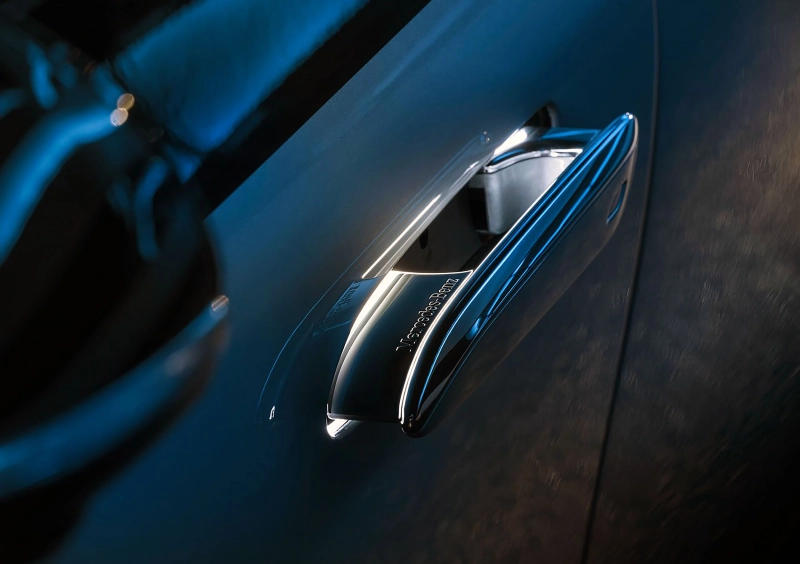
Death by design: The end of the era of retractable handles? China bans them from 2027, and Europe could follow suit
An innovation that promised a minimalist future and superior aerodynamic performance is turning into a regulatory nightmare. Electrically operated retractable handles (so-called "flush handles") have become the target of Chinese authorities, who have decided to ban them from January 1, 2027.
The measure comes after a tragic string of accidents in which passengers were trapped in cars with their electronic systems locked, and rescuers watched helplessly through the windows without being able to operate the doors from the outside.
China sounds the alarm: Safety before aesthetics
China's Ministry of Industry and Information Technology (MIIT) has published a draft law that imposes strict rules for all vehicles under 3.5 tons:
- Mandatory mechanical operation: Each door must have a handle (interior and exterior) that can be operated mechanically, without depending on the car battery.
- Visibility and access: Interior emergency handles should be visible and easy to find under stress, not hidden under upholstery or in the armrest.
- Standard dimensions: To allow rescuers a good grip, external handles must comply with minimum dimensions (approximately 60 × 20 × 25 mm).
Will the measure also be adopted in Europe?
While the European Union has yet to issue a blanket ban, pressure is mounting rapidly. In 2025, organizations such as the European Transport Safety Council (ETSC) and the Dutch authority RDW (which homologates Tesla models for the EU) declared door safety an “absolute priority.”
Major changes from 2026:
- Euro NCAP has announced that, starting with the 2026 test protocol, cars will lose massive safety points if the power handles do not automatically extend immediately after impact or if there is no intuitive mechanical override.
- Basically, a manufacturer that wants to achieve 5-star safety in Europe will be forced to abandon exclusively electric handles or radically redesign them.
Tragedies in Europe: When seconds count
The problem is not theoretical. In September 2025, a shocking accident occurred in Schwerte, Germany, where a father and his two children perished in a burning Tesla after witnesses were unable to open the doors from the outside.
In Romania, although no deaths directly caused exclusively by the blocking of retractable handles have been officially reported, communities of electric car owners have reported numerous "minor" but alarming incidents:
- Frost: Romanian winters have shown that electrical mechanisms frequently get stuck under the layer of ice, leaving drivers trapped outside the vehicle.
- Power failure (12V): Failure of the 12V auxiliary battery (a common problem in electric vehicles) causes the doors to no longer respond to either the key or touch, requiring complicated service interventions.
"People are dying because they can't get out of their vehicles when every second counts. This is not an aesthetic issue, it's a matter of life and death," said Antonio Avenoso, executive director of ETSC.
What cars with retractable handles are on the roads in Romania?
Although they seem rare, the number of models using this technology has grown exponentially in the last two years in Romania, with the invasion of electric vehicles and luxury SUVs. Here are the main models you can encounter in our traffic, divided by access categories:
1. Tesla Models (Largest fleet in Romania)
Tesla is the clear leader in this regard. Thousands of units are circulating in Romania using two different systems:
- Tesla Model 3 and Model Y: The handles are flush with the body, but they are not motorized. You have to press on the wide side for the handle to pivot outward.
- Tesla Model S: The handles extend automatically (they are motorized) when you approach the car with the key or phone.
2. New Chinese brands entering the local market
With the year 2024, new brands from China began to officially market models with "invisible" handles in Romania:
- BYD Seal: A sporty sedan where the handles completely protrude from the door.
- Jaecoo 7: A recently launched mid-size SUV that relies on a minimalist design with fully electric retractable handles.
- MG4 Electric: Although the basic version has classic handles, certain top versions or special editions have adopted a more fluid design.
3. Hyundai-Kia Group
The Koreans have adopted a hybrid solution, where the handles open automatically, but also have a manual pivoting function:
- Hyundai IONIQ 5 and IONIQ 6: Both models use handles that "pop" outward.
- Kia EV6 and EV9: The large electric SUV EV9, present in showrooms in Romania, uses fully retractable handles to improve aerodynamic coefficient.
4. Premium and Luxury Brands
In the luxury segment, this feature has become almost a standard for new generations:
- Mercedes-Benz (EQ Range): The EQE and EQS models (both sedan and SUV) have handles that retract completely, leaving the door perfectly smooth.
- Range Rover: The Velar, Evoque and new Range Rover Sport models have been using this system for over 5 years, being among the first to report problems with freezing during winter in the mountainous areas of Romania.
- BMW 7 Series and i7: The new models use a "niche" with an electric button, but which visually offers the same "flush" appearance (at body level).
5. Volkswagen Group
- ID.4 and ID.5: While they are not "retractable" in the sense that they do not physically move much on the outside, they use a fixed flap with an electric switch on the inside. If the electricity fails, these doors have an emergency opening mode by pulling harder on the handle to activate the backup mechanical cable.
If you are involved in an accident with one of these models on the roads of Romania, the first instinct of rescuers (witnesses or firefighters) will be to look for a handle to pull. The lack of one can delay the extraction by tens of critical seconds.
Conclusion: A step back for design, a leap for safety
The aerodynamic gain brought by the "hidden" handles is, in reality, negligible — less than 0.1 kWh/100 km. Faced with the risk of getting stuck in a burning car, this benefit seems irrelevant.
It is very likely that, by 2027, the global market will return to classic handles or hybrid systems that, although they look modern, retain a physical, mechanical connection between the human hand and the door lock.