Coming into force: Audi starts the race for Formula 1 supremacy
From the sand dunes of Dakar, to the legendary curves of Le Mans, to the historic climb of Pikes Peak, Audi has built an unrivaled reputation in motorsport: that of a manufacturer that doesn't just participate, it dominates. The Latin words "Veni, Vidi, Vici" – I came, I saw, I conquered – seem to be the unofficial motto of the brand with the four rings.
Now, having conquered almost every major "territory" in motorsport, from the World Rally Championship (WRC) and DTM, to Formula E and most recently the Dakar Rally with an electric car, Audi is preparing for the last remaining frontier: Formula 1.
The Germans' entry into the Grand Circus, scheduled for the 2026 season, is not just a simple participation, but a declaration of intent supported by a meticulous strategy and a clear objective: the fight for the world title by 2030.
2026: The Perfect Time for a Revolution
Audi's entry into F1 is no coincidence. The 2026 season marks a fundamental reset of the technical regulations, providing an ideal tabula rasa for an ambitious new manufacturer.
The changes target the pillars on which Audi already bases its brand strategy: electrification and sustainability.
New Power Unit: 50% Thermal, 50% Electric
The most significant change is found at the power unit level. Formula 1 will switch to a ratio of 50% power from the internal combustion engine (V6, 1.6 liters, 540 hp) and 50% from the electric one. This is achieved by:
- Elimination of MGU-H: The complex heat recovery system is taken out of the equation.
- MGU-K Enlargement: The Kinetic Energy Recovery Unit (MGU-K) sees its power increased massively, from 160 hp to 470 hp.
This rebalancing, together with the use of 100% sustainable fuels, makes the 2026 F1 engine more relevant than ever for production car technology. For Audi, with its recent experience in Formula E and victory in the Dakar with an electric prototype (RS Q e-tron), this direction is a strategic advantage.
Lighter Single-Seaters and Dynamic Aerodynamics
The single-seaters will be smaller and more agile, being 200 mm shorter and 100 mm narrower, resulting in a weight reduction of 30 kilograms.
In addition, the aerodynamic regulations will introduce active front and rear wings, replacing the traditional DRS system. This new dynamic system, called Manual Override, will provide temporary additional power to facilitate overtaking, increasing the spectacle and challenging the ingenuity of German engineers.
A Team Structured for Success
Entering F1 is not just about engines, but about the ecosystem. Audi has taken a pragmatic and strong approach, securing the necessary expertise.
Strategic Partnership with Sauber
Instead of starting from scratch, Audi has taken over the Sauber team (previously known under various names), a name with a rich history in F1 since 1993. This move gives Audi immediate access to:
- Existing infrastructure: Headquarters and factory in Hinwil, Switzerland, including one of the most advanced wind tunnels in the world.
- Human expertise: A team with decades of experience in operating a Formula 1 car.
The German Heart: The Unity of Power
In contrast to the rest of the team, which operates in Switzerland, the engine and 8-speed semi-automatic gearbox will be designed and built at the Audi plant in Neuburg an der Donau, Germany. This makes Audi the only team with an engine production facility in Germany, marking a symbolic return of the country to the front lines of the Grand Prix.
Top Management and Driver Lineup
To turn the ambition into reality, Audi recruited big names from F1:
- Mattia Binotto: Former Ferrari boss takes on a leadership position.
- Jonathan Wheatley: Former Red Bull team sporting director becomes Team Principal.
In the cockpit, Audi is relying on a mix of experience and emerging talent:
- Nico Hülkenberg: The German brings extensive experience (approx. 250 races) and stability.
- Gabriel Bortoleto: The young Brazilian, reigning F3 (2023) and F2 (2024) champion, represents the future of the team.
R26: The Aesthetics of Domination
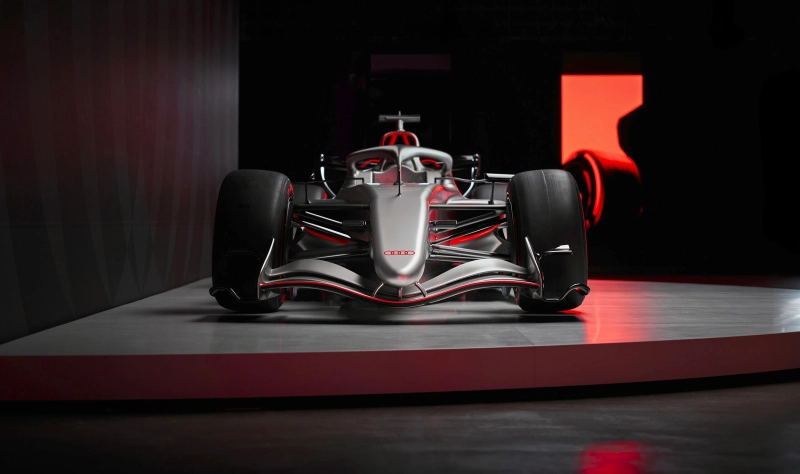
The prototype of the first single-seater, christened R26, unveiled in Munich is not just a car, but a design statement. The color scheme is dominated by a special shade of gray that imitates titanium, elegantly contrasted with carbon black and bold red inserts.
Massimo Frascella, the design director, emphasizes that this unified visual language is the pioneer of Audi's new brand identity, following the four principles: clear, technical, intelligent and emotional.
Final Goal: World Title
Audi's entry into F1 is backed by a robust business plan. As CFO Jurgen Rittersberger says, thanks to the cost cap and the rapid growth of the young audience, F1 is now financially sustainable and a global brand catalyst.
But the ambition goes beyond the financial sphere. Audi CEO Gernot Dollner perfectly summarized the team's philosophy:
"We're not getting into Formula 1 just to be there. We want to win. By 2030, we want to fight for the world championship title."
With a history full of resounding successes, a top team, a well-defined strategy centered on the new technical regulations and a bold goal, Audi is not entering Formula 1 to be a mere competitor, but to continue the tradition of dominance that has always defined the brand. Formula 1 is the last stronghold, and Audi has already begun the assault.