Mercedes-Benz CLA 2026 crash test, side collision results, battery protection and technical details
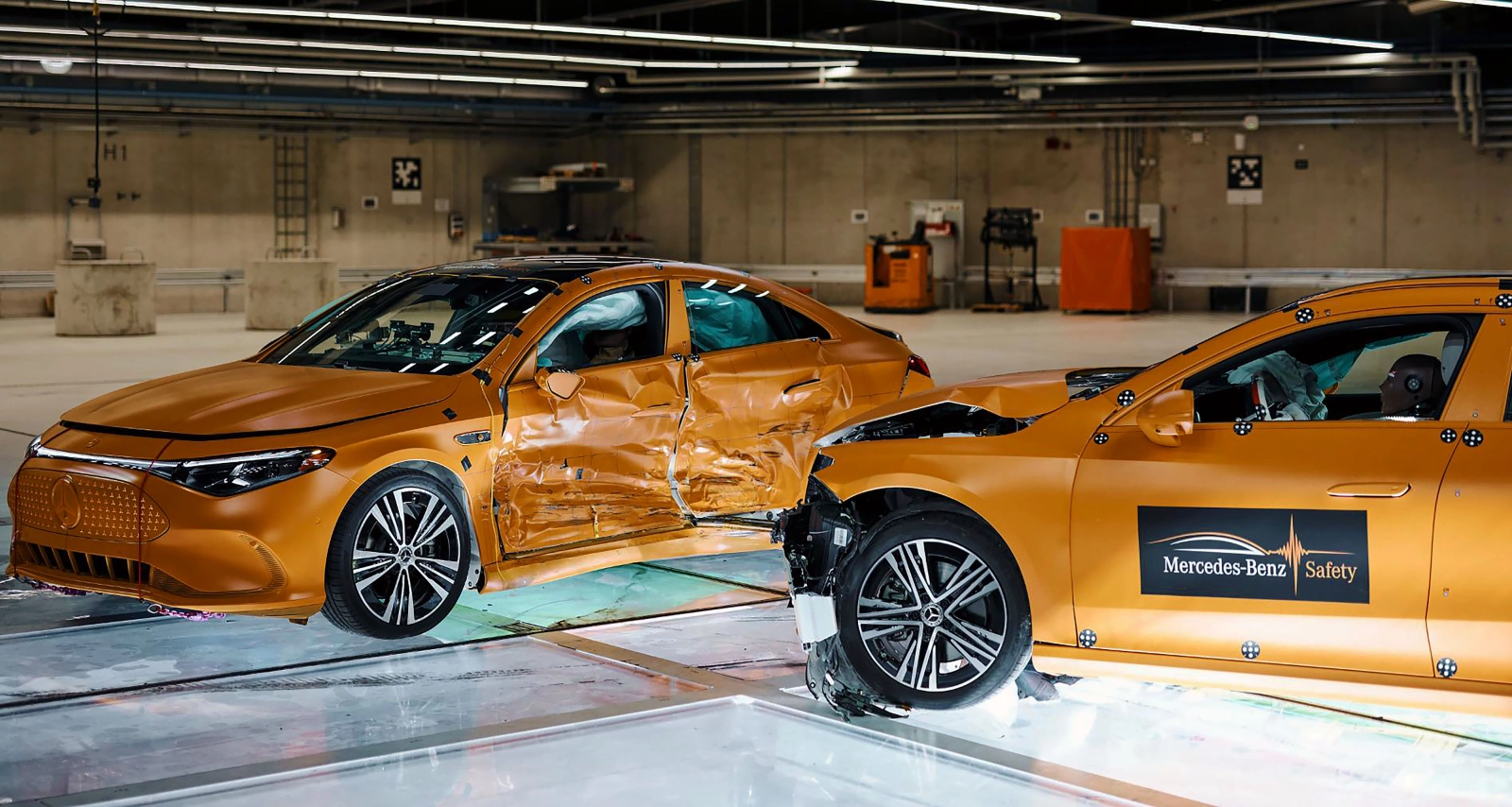
When it comes to passenger protection and passive safety standards, the German brand maintains its status as an absolute pioneer with innovations that go far beyond the standardized homologation requirements. In an unprecedented demonstration of technical strength, the Stuttgart-based manufacturer put two production models of the new Mercedes-Benz CLA family head-to-head in a high-speed side collision.
A world premiere: Two production vehicles in a direct side collision
The experiment involved the controlled impact of two moving cars, without either driver (or system) applying the brakes before the moment of collision.
- The main actors: A purely electric Mercedes-Benz CLA Sedan was hit head-on on the side by a CLA Shooting Brake equipped with a hybrid drive system.
- Impact parameters: Both vehicles were traveling at a constant speed of 56 km/h at the time of the simulated accident.
Such a configuration is considered by engineers to be one of the most critical and violent situations on the road, as the sides of a car have much less space to absorb kinetic energy than the front. The test directly targeted sensitive points: the integrity of the passenger compartment and the security of the high-voltage battery located in the floor.
"Real-Life Safety" Philosophy: Based on thousands of real accidents
The decision to choose exactly this speed and impact geometry was not left to chance, but has its roots in real-life accident research that Mercedes-Benz has been systematically conducting since 1969.
- Tradition and global research: Over the 57 years of activity of the specialized department, research teams from Germany, China and India have closely analyzed approximately 6,000 real accidents.
- Why 56 km/h? Field statistics have shown that 56 km/h is the upper limit of accidents that frequently occur at intersections, exceeding the averages recorded in congested urban traffic. By replicating these extreme conditions in the laboratory, the manufacturer manages to translate real-life scenarios directly into the strict development requirements of new vehicles.
Experiment results: Rigid structure and intact battery
Data collected following the violent side impact confirmed the effectiveness of the safety measures implemented on the new CLA models.
- Cabin Integrity: Despite the enormous force released at an extremely rigorous cumulative test speed, the passenger safety cell remained completely intact in both cars.
- Occupant protection: The 8 dummies used in the test – symmetrically representing 4 adults and 4 children – provided data via numerous measurement points. All recorded values remained below the relevant biomechanical limits, indicating minimal risk of serious injury or life-threatening injury.
- Electrical system safety: In the case of the electric variant, the high-voltage battery integrated into the subchassis passed the ultimate test without any damage, maintaining its tightness and structural integrity following the direct hit.
Vital help for intervention teams: The new Rescue Intelligence system
In addition to the structural validation of the CLA models, the event also marked the presentation of a major innovation in post-accident assistance: the Mercedes-Benz Rescue Intelligence system.
- Scheduled launch: This advanced technology is set to be gradually introduced on the brand's models starting in 2027.
- Real-time data flow: The system is designed to provide emergency crews (such as firefighters and extrication teams) with critical information as they move towards the scene.
- What does the platform display? Authorities will be able to quickly view the exact number of occupants on board, the operational status of airbags and seatbelt tensioners, which doors have been opened, as well as the battery temperature and safety parameters of the high-voltage system.
With instant access to this data, rescuers can select the right equipment much faster, turning every second gained into an extra chance to save lives.