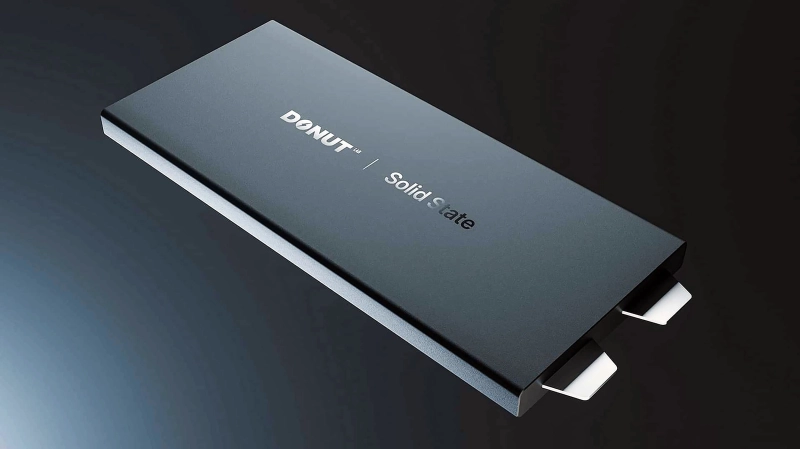
Revolution in Finland: Donut Lab's Solid-State Battery Promises 5-Minute Charging and a Lifespan of 100,000 Cycles
While automotive giants were promising solid-state batteries only towards the end of the decade, a Finnish company decided to accelerate history. Donut Lab, a technology startup now owned by motorcycle manufacturer Verge Motorcycles, presented the first "all-solid-state" battery ready for series production at CES Las Vegas 2026.
The announced performance is not just a step forward, but a giant leap that could make internal combustion engines completely irrelevant.
Performances that defy current physics
The battery developed by the Finns, simply called the "Donut Battery", comes with specifications that seem straight out of science fiction:
- Record-breaking charging: A full charge (0-100%) takes just 5 minutes. Unlike current lithium-ion batteries, which require charging to be limited to 80% to prevent degradation, the Donut Lab solid-state battery can be charged to full capacity every time.
- Superior energy density: With 400 Wh/kg, the new battery significantly exceeds the current threshold of 250-300 Wh/kg. This means either lighter vehicles or almost double the range in the same volume.
- Extreme longevity: The lifespan is estimated at 100,000 charge cycles. If a typical electric car travels 300 km on a charge, this battery could theoretically last for 30 million kilometers – far exceeding the lifespan of any vehicle ever built.
- Temperature resistance: Finnish technology solves the "Achilles heel" of electric cars: cold. The battery retains 99% of its capacity at -30°C, but works just as efficiently at extreme temperatures of over 100°C, without the risk of fire or degradation.
"Green" materials and geopolitical independence
A crucial aspect of this innovation is sustainability. Donut Lab confirmed that the battery does not use rare earths or geopolitically critical materials (such as cobalt or nickel in problematic quantities).
The composition is based on abundant, “green” and globally accessible materials. This approach not only reduces environmental impact, but also promises lower production costs than current lithium-ion batteries, eliminating dependence on fragile supply chains.
Impact on the electric car industry
If Donut Lab's technology is adopted on a large scale, the impact on the automotive industry will be seismic:
- The disappearance of “range anxiety”: When a full charge takes as long as a full tank of gas, the need for giant (and heavy) batteries disappears. Cars can become smaller, more efficient, and more affordable.
- Charging infrastructure: The focus will shift from the number of slow charging stations to the power of the network. A car that charges in 5 minutes requires high-power stations, but will free up space much faster, reducing queues.
- Resale value: Currently, electric cars lose value rapidly due to battery degradation. A battery with a 100,000 cycle life means that the battery will be the part that will “outlive” the car, and can be reused in other vehicles or energy storage systems for several more decades.
- Total safety: Being composed of a solid electrolyte, the risk of fire in the event of an accident (thermal runaway) is practically eliminated.
From the laboratory to the road
Unlike other similar announcements, Donut Lab's technology is not a far-fetched concept. The first vehicle to benefit from the system is the Verge TS Pro electric motorcycle, with deliveries planned for the first quarter of this year.
Finland is thus demonstrating that disruptive innovation does not always come from large automakers, but from laboratories that have the courage to rethink the basic chemistry of energy. If the promises are confirmed in everyday use, we are witnessing the end of the era of internal combustion.