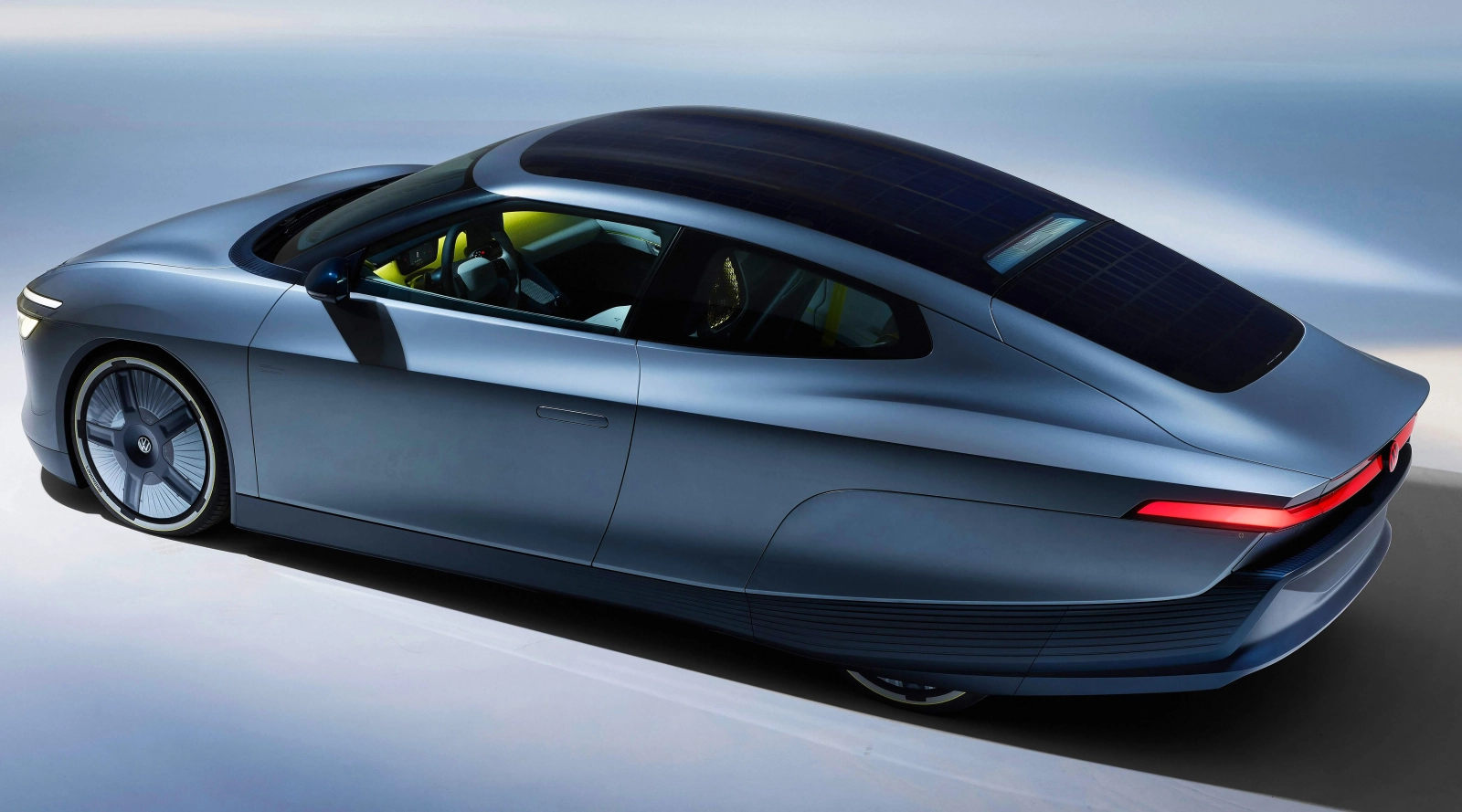
Volkswagen Mission Efficiency: The electric concept that rewrites the rules of aerodynamics and sets three world records
German manufacturer Volkswagen has officially unveiled its new Mission Efficiency prototype, a vehicle created with one ultimate goal: to push energy efficiency to the limits of what is possible on public roads. Approved for road use, the new concept has already proven that modern performance is not measured only in horsepower, but in kilometers traveled with minimal energy consumption, managing to break no less than three world records.
Extreme aerodynamics – 0.158 drag coefficient
The secret behind the Mission Efficiency model's remarkable efficiency lies in its body shape, meticulously sculpted in the wind tunnel. The concept boasts an aerodynamic drag coefficient of just 0.158 Cd, setting a new world record for road-legal cars.
To achieve this figure, the Wolfsburg engineers designed a front end with an extremely small frontal area and almost completely covered the rear wheels to eliminate air turbulence. The bodywork integrates active cooling vents that automatically close when ventilation is not needed, and the car's floor has been completely faired to optimize the airflow underneath.
The result? 30% less energy consumption compared to a Volkswagen ID. Polo. At a cruising speed of 140 km/h, the Mission Efficiency requires exactly the same amount of energy as the ID. Polo consumes at just 100 km/h.
Trial by fire – 1.278 kilometers through four European countries
To validate the theoretical performance in real conditions, Volkswagen subjected the concept to a marathon test on a 1,278-kilometer route, crossing Germany, Poland, the Czech Republic and Austria.
The trip certified the car's second world record: a consumption of only 6.48 kWh/100 km obtained under ideal driving conditions (constant speed of 68 km/h, route without altitude differences and without active secondary consumers).
In real traffic conditions — with air conditioning and terrain variations — the results at the end of the almost 1,300 kilometers were downright impressive:
- Real average consumption: 7.51 kWh / 100 km
- Average speed: 67.72 km/h
- Maximum speed reached: 138 km/h
- Only one charging stop along the entire route
- Remaining range to destination: 164 kilometers
These figures also gave the model its third world record: the title of the most efficient electric car in its segment.
Streamlined drivetrain and a first in the braking system
Under the futuristic bodywork lies a technical package optimized for maximum economy. Propulsion is provided by a single 135 hp electric motor, powered by a compact battery with a net capacity of 54.9 kWh.
The reduced weight of the battery pack directly contributes to handling and reduced friction. On the chassis level, the car uses a MacPherson strut suspension on the front axle and a hydraulic braking system taken from the ID. Polo.
The great technical innovation, however, occurs on the rear axle: for the first time, Volkswagen is using an electromechanical brake on the rear wheels. This solution eliminates the residual friction of traditional pads, enables much more precise energy recovery during deceleration and improves the vehicle's stability when cornering.
Dimensions, interior space and the "Bring Your Own Device" concept
Despite being an ultra-efficient vehicle, Mission Efficiency does not sacrifice practical space. With a length of 4,775 mm and a low height of 1,392 mm, the car offers space for 4 passengers and a generous boot with a capacity of 481 liters. Additional storage spaces have been cleverly integrated under the rear seats and in the side panels of the body.
The interior follows a strictly minimalist philosophy, eliminating heavy and unnecessary elements:
- Portable audio system: Instead of heavy speakers in the doors, the car uses a removable Bluetooth speaker.
- Mobile multimedia system: With the "Bring your own device" concept, the driver uses his own tablet or smartphone as a central screen for navigation and infotainment, thus reducing the overall weight and energy consumption of the on-board electronics.
Free energy from the sun – Photovoltaic ceiling
For added autonomy, Volkswagen has integrated a 370 W photovoltaic panel system into the glass roof and tailgate.
The system captures solar energy while driving or while the car is parked. Depending on the season and weather conditions, the solar cells can add up to 30 kilometers of free range per day, ensuring daily commuting without the need for a connection to the electrical grid.
With the Mission Efficiency concept, Volkswagen is not just presenting a style exercise, but also offering a concrete preview of the energy efficiency technologies that will be implemented on the brand's future series models.